The Best Time to Visit Langkawi: Rainfall, Crowds and Jellyfish
Updated September 30, 2026 · 7 min read
Langkawi sits at about 6 degrees north, which means the temperature barely moves all year. What moves is the rain, and it moves by a factor of fifteen.
These are the 2000–2020 monthly averages (source: Climates to Travel):
| Month | Rainfall | Rainy days |
|---|---|---|
| January | 23.9 mm | 3 |
| February | 32.7 mm | 5 |
| March | 104.8 mm | 10 |
| April | 196.6 mm | 15 |
| May | 206.9 mm | 18 |
| June | 249.9 mm | 17 |
| July | 265.5 mm | 19 |
| August | 319.2 mm | 19 |
| September | 340.6 mm | 21 |
| October | 372.5 mm | 23 |
| November | 193.0 mm | 16 |
| December | 57.5 mm | 8 |
The year totals about 2,363 mm across 174 rainy days. January has three of them. October has twenty-three.
The short answer
December to March is the dry season, and January and February are the heart of it. Three to five rainy days in a month is effectively a dry holiday. This is when the sea is flattest, the cable car view is clearest, and boat trips are least likely to be called off.
April and May are the shoulder. Rain returns properly — fifteen to eighteen wet days — but it usually arrives as a heavy afternoon burst rather than a grey day. Mornings are often fine, and morning is when the boats go anyway.
June to November is the wet half. Not unusable, and prices reflect it, but October in particular is a month with rain on more days than not.
What rain actually does to your plans
A rainy day in Langkawi is not a European rainy day. It is usually an intense downpour of an hour or two, often mid to late afternoon, with sun on either side. Twenty-three rainy days in October does not mean twenty-three washed-out days.
What it does mean:
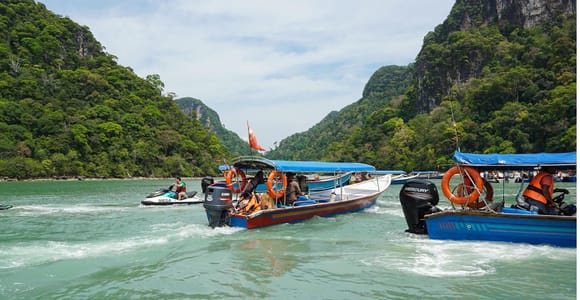
Boat trips still run. An open longboat in the mangroves runs in rain. You get wet, the trip is not cancelled, and there is no refund for weather you could have looked up. The three-hour shared cruise at €15.69 is a reasonable gamble in the wet months precisely because it is short and cheap.
Sea state cancels things, rain does not. The crossings that get called off are the exposed ones — the archipelago runs and the jet ski tours. Sheltered mangrove channels are far more reliable. If you are travelling in the wet half and one boat trip is the thing you came for, book it early in your stay so there is room to rebook.
The mountain clouds over. The cable car view is a morning proposition all year, and in the wet months it is a first-hour proposition. See the SkyCab guide — including the Wednesday when it does not open until noon.
Indoor options are genuinely good here. The aquarium, the water park and the after-dark forest walk are all covered in Langkawi with children, and they are not consolation prizes.
The crowds follow a different calendar
This is the part that catches European visitors, and it is the most important thing on this page after the rain table.
Langkawi is overwhelmingly a domestic destination. In the first half of 2025, of 1,525,953 visitors, 1,325,225 were Malaysian — about 87 per cent. The international markets named alongside them are India, China, the United Kingdom, Poland and Russia.
That changes what “busy” means. The island fills up for Malaysian school holidays, Chinese New Year and the Hari Raya period, and those dates move with the lunar and school calendars rather than with the weather. A wet-season weekend during a school break can be fuller than a dry-season Tuesday in February.
Practically: check the Malaysian school holiday calendar for your dates before you assume the low season is quiet. And if you are going in a busy week, the express-lane upgrade on the cable car stops being an optional extra.
Jellyfish: the honest version
There is no jellyfish-free season in Langkawi, and anyone who tells you otherwise is guessing.
Box jellyfish occur in these waters. In November 2025 a two-year-old Russian child died of complications from a sting at Pantai Cenang. The Langkawi Development Authority responded by commissioning a study of jellyfish behaviour and population patterns with the Centre for Marine and Coastal Studies at Universiti Sains Malaysia, and by improving signage, warnings and monitoring at busy beaches.
Sources differ on which months are worst — the periods between the main seasons are often named, but the reporting is inconsistent and there is no published seasonal model yet, which is precisely why the study exists. Treat the risk as year-round:
- Read the signs on the beach you are actually on, and respect a closure.
- Long sleeves and leggings in the water are normal here.
- Know where the nearest clinic is. LADA’s stated first-aid advice is to rinse a sting with vinegar as soon as possible and get medical help.
For anything you might want to carry, ask a pharmacy or your doctor before you travel. We are not a medical source.
Month by month, briefly
- January, February — the best weather of the year, and the busiest international season with it. Book boats and hotels ahead.
- March — still good, rain building. A good compromise month.
- April, May — hot, humid, afternoon storms. Prices soften. Mornings work.
- June, July — wet but not the worst of it, and the quietest stretch for international visitors.
- August, September — wet, and the sea gets less reliable.
- October — the wettest month of the year. Go if the price is right and the plan is flexible.
- November — the turn. Rain drops sharply from October, and the last third of the month is often already good.
- December — dry weather returns properly, and the holiday crowds arrive with it.
What to book when
In the dry months, book the things that sell out: the Kilim mangrove boats with morning departures, and the cable car for an early slot.
In the wet months, book short and book early in your stay. The island hopping trips and the jet ski tours are the ones most likely to be moved by sea state, and a cancellation on your last morning has nowhere to go.