Seven Wells and Langkawi's Other Waterfalls: What You Can Do on Foot
Updated September 30, 2026 · 7 min read
Start with the part that saves you money: Langkawi’s waterfalls are free. Telaga Tujuh, Temurun and Durian Perangin all have a car park, a path and no ticket office. Nobody has to buy a tour to stand under any of them.
So the useful questions are not which tour to book. They are: how hard is the walk, how do you get to the trailhead, and — the one nobody asks until they are standing at the bottom of a dry rock face — will there be any water.
The timing problem nobody mentions
Langkawi’s driest months are December to March, and that is when most visitors come and when we recommend coming. It is also when the waterfalls are at their weakest.
These are rain-fed streams on a small island. They run hard in the wet half of the year and they can slow to a trickle in a long dry spell. Guides to Telaga Tujuh routinely say the falls are at their best roughly from September to December, which is almost exactly the stretch the weather advice tells you to skip.
Both things are true, and you do not have to resolve the contradiction — you just have to know which trip you are taking. In February you are going for the rainforest, the rock pools and the view, with a modest flow of water. In October you are going for a waterfall, and getting wet on the way is part of it.
One practical rule covers both: go in the day or two after heavy rain, not during a dry week. That single choice matters more than the month.
Telaga Tujuh — the Seven Wells
The famous one, and the one that takes actual effort.
It sits on the cliffs of Gunung Mat Chinchang facing Burau Bay, on the north-western corner of the island. The approach is straightforward: past Pantai Kok, turn opposite Burau Bay Resort. It is a few minutes from the Oriental Village, which means from the base station of the SkyCab cable car — the two are an easy pairing on one morning, and the cable car ride passes above the falls.
The name comes from seven natural pools linked by the stream, which spills from one into the next down the hillside. Local tradition has it that seven princesses came down from the sky to bathe in them, and that a prince who watched them failed to persuade one to stay. The water has long been said to cure things.
The climb is a concrete staircase, and it is steep. Sources disagree on how many steps there are: Wikipedia puts it at around 900 to the first section, while several walking guides count roughly 200 up to the lower pools and 638 to the upper ones. What they agree on is the time — most people take 45 minutes to an hour to the top, and considerably less coming down.
That gives you two different outings:
- The lower pools are the short version. A plunge pool at the foot of the main drop, the vertical face above you, and rock that is genuinely slippery. This is where most people stop, and it is a perfectly good visit.
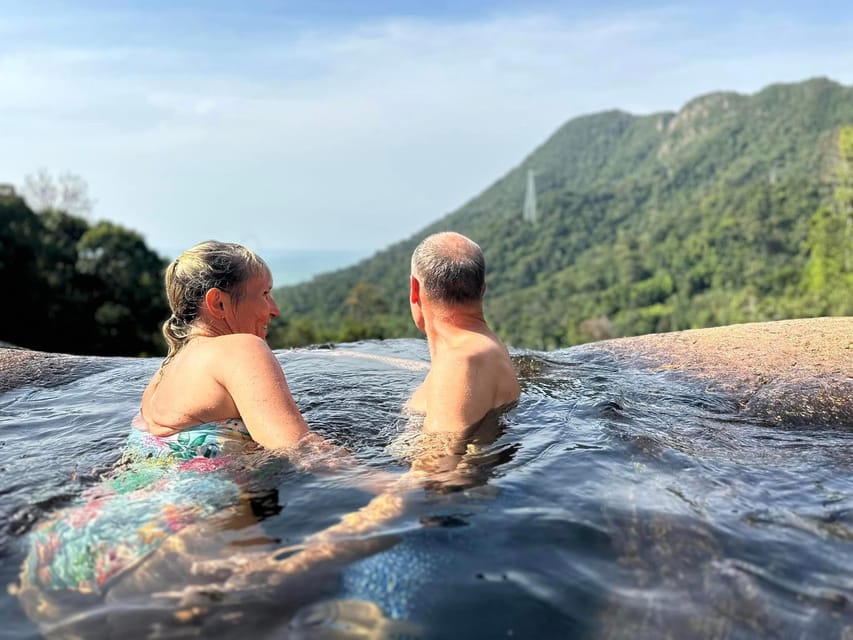
- The upper pools are the seven the place is named after, sitting in the sandstone above the main fall, with a natural rock slide between some of them and a view out over the treetops to the sea. This is what the climb buys you.
The cliff itself is high — the drop is usually given as 90 to 91 metres — and you are climbing beside it, not up it.
Be honest with yourself about the stairs. This is not a walk for a pushchair, for anyone unsteady on wet steps, or for the hottest part of the afternoon. Go early. There is no shade discipline on a concrete staircase in the tropics.
Temurun — the tall one with the short walk
Temurun is Langkawi’s tallest waterfall and its easiest. It lies on the road towards Datai, inside the Machinchang Cambrian Geoforest Park, and the walk from the car park to the foot of it takes only a few minutes on a made path.
The height quoted for it is large — commonly around 200 metres across three tiers — but that is the whole cascade, not a single drop, and what you actually stand in front of is the bottom tier with its shallow pool. Entry is free.
If Seven Wells sounds like more staircase than you want, this is the waterfall to choose. It is also the one to choose in the wet season, when it is at its most impressive and the effort-to-reward ratio is at its best on the island.
Durian Perangin — the quiet one
On the northern slope of Gunung Raya in the north-east, away from the cable car crowds. It comes down in a long series of tiers — fourteen of them, by the usual count.
Only the lower two are an easy walk from the car park. Above that you are scrambling on wet rock, and that changes the nature of the outing entirely. Walking apps put the accessible section at around 0.4 miles with roughly 170 feet of ascent, half an hour to an hour there and back.
This is the one to pick if what you want is somewhere to sit in cool water without a queue.
When a tour is actually worth paying for
Given that all three are free, the tours are buying you three things: transport, a guide who knows whether there is water this week, and other stops.
The Seven Wells and sacred blue pool trip at €60.51 with 23 reviews is the straightforward version — the falls plus a second swimming spot, with someone driving.
The jungle and waterfall adventure at €67.01 is a different animal and by far the better-reviewed at 120. It is an ATV ride — two hours through jungle trails, hills, countryside and rubber plantations, with a ten to fifteen minute waterfall stop and an optional swim. Read that timing carefully before booking it as a waterfall trip: the waterfall is the break, not the destination. As an ATV trip that is a good ride; as a way to see a waterfall it is a quarter of an hour.
The countryside bike tour with a waterfall swim sits between the two, and takes you through the rice fields and villages rather than past them.
Across the whole waterfall and jungle listing there are 25 trips starting at €36.98. That is the floor. If you have your own transport, the floor is nothing at all.
Getting to the trailheads
This is the real constraint, and it is worth saying plainly: the waterfalls are on opposite corners of the island. Telaga Tujuh and Temurun are in the north-west, Durian Perangin in the north-east. There is no bus that usefully links them, and ride-hailing coverage away from Cenang and Kuah is thin enough that getting back can take longer than getting there.
If you would rather not drive yourself, a car with a driver for the day covers all three with time left over, and that is a different article: what a private island tour actually includes.
What to take
- Shoes with grip. Wet sandstone is the hazard here, not the height.
- Water and a start before 10 am. The staircase at Seven Wells faces the sun.
- A dry bag. All three of these are places you get into, not just look at.
- Small notes. There are stalls at the Seven Wells car park; there is no card machine on a rock.